Immersive virtual reality for naturalistic paradigms — where participants move, look, and act inside richly controlled 3D worlds, opening new windows onto spatial cognition, navigation, and scene perception.
Maintained by the Robertson Lab · Shared on requestThe Shared VR Lab brings head-mounted virtual reality to Dartmouth's brain and behavioral research community. Immersive, stereoscopic environments let investigators study perception and cognition under conditions that feel natural to the participant while remaining precisely defined by the experimenter — an approach especially suited to spatial cognition, navigation, and embodied experience.
The facility is maintained by the Caroline Robertson Neuroscience Lab, led by Dr. Caroline Robertson. High-end head-mounted displays with room-scale, inside-out tracking follow the participant's position and viewpoint in real time, while integrated eye tracking records where attention is directed within the scene. The system is driven by a high-performance GPU workstation and can be synchronized with physiological or eye-tracking recording for multimodal studies.
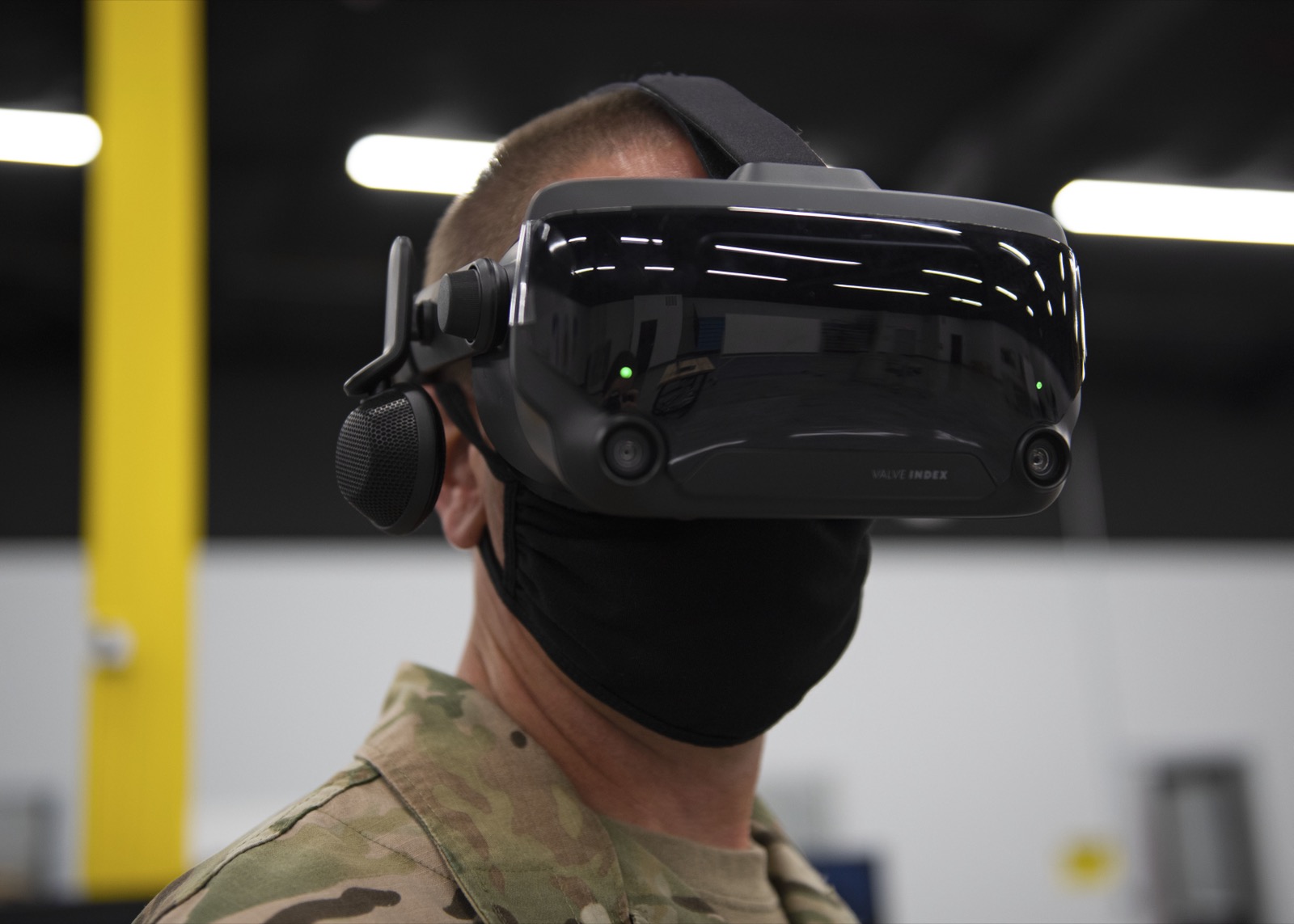
A flexible platform for building and delivering immersive experiments with fine-grained control over what participants see, hear, and do.
Fully enclosing, binocular 3D worlds rendered in real time to place participants inside naturalistic scenes.
Inside-out, room-scale tracking follows head and body position so participants can physically move and explore.
Integrated gaze tracking records where attention falls within the virtual scene, moment to moment.
Experimenter-defined environments give exact control over timing, layout, and the appearance of every element.
Combine visual, auditory, and interactive cues to create coherent, multisensory naturalistic experiences.
Sessions can be synchronized with physiological or eye-tracking recording for multimodal data collection.
The lab pairs high-end head-mounted displays with a workstation built for real-time rendering, so complex, detailed environments run smoothly throughout a session.
Immersive VR opens experimental questions that are difficult to pose with flat-screen displays, from how we find our way through space to how we experience our own bodies.
Study how people learn, remember, and move through large-scale spaces using active, self-directed exploration.
Investigate the sense of body ownership and agency when a participant inhabits a virtual body or perspective.
Examine how rich, immersive scenes are perceived and understood when viewers can look and move freely.
Deliver carefully graded, repeatable immersive scenarios for exposure-based experimental designs.
The Shared VR Lab is maintained by the Caroline Robertson Neuroscience Lab and is available to the Dartmouth research community on request. Reach out to discuss your paradigm, scheduling, and how the setup can be tailored to your study.