Petabyte-scale storage, a campus supercomputer, and dedicated GPUs — the compute backbone that turns raw scans into analyzed results. DartFS, the Discovery HPC cluster, and dedicated H200 accelerators put large-scale neuroimaging within reach.
Dartmouth Research Computing + DBIC · Shared across campusNeuroimaging is data- and compute-heavy: a single study can span terabytes of raw and derived images and thousands of preprocessing jobs. Dartmouth's research computing environment brings three layers together — the DartFS network file system for durable, snapshot-protected storage; the Discovery high-performance cluster running Slurm for massively parallel batch work; and dedicated GPUs for deep learning and accelerated pipelines. Data written on DartFS is mounted directly on Discovery, so there is no copying between storage and compute.
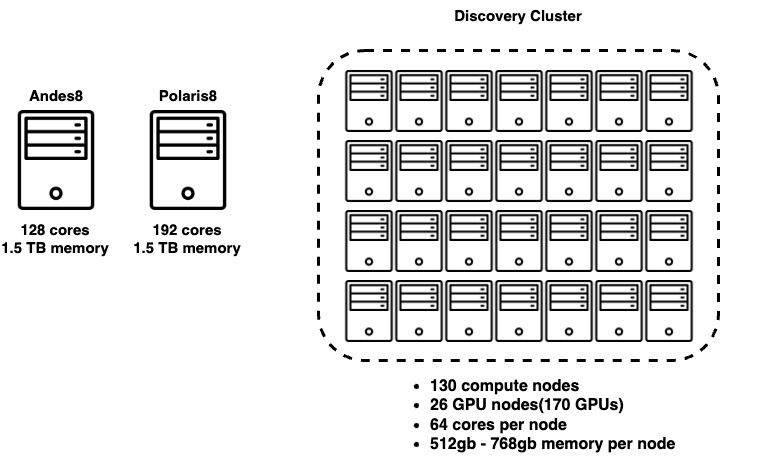
The Discovery cluster and DartFS deliver campus-scale capacity, with a dedicated 230 TB allocation for the CANlab on DartFS-hpc.

DartFS is a high-speed network file system built on roughly 3.9 PB of Dell/EMC PowerScale hardware. Home directories come with 50 GB of free space, and each faculty lab receives 1 TB of free shared storage that can be expanded. Daily, weekly, and monthly snapshots protect against accidental loss, with self-service restore so researchers can recover files without a support ticket.
Discovery is Dartmouth's shared research cluster — 128 nodes and 6,712 CPU cores running RHEL 8 over a 10 GbE fabric, scheduled with Slurm. Preprocessing pipelines, tractography, and machine-learning jobs run at scale and read directly from DartFS.
128 nodes · 6,712 cores · 54.7 TB memory · >2.8 PB disk · RHEL 8 · 10 GbE interconnect.
10× A100, 72× A5500, and 12× V100, plus newer L40s and A5000 accelerators.
Two Penguin nodes — AMD EPYC 9334 (64 cores), 1.5 TB RAM, 2× NVIDIA H200 each.
15 nodes / 240 cores, bursting to ~1,200 cores through Research Computing sharing.
Log in at discovery7.hpcc.dartmouth.edu; the DBIC interactive node is Ndoli.
Shared Andes and Polaris nodes with 1.5 TB RAM for memory-hungry analyses.
Beyond the shared pool, the group operates dedicated hardware for deep-learning and priority workloads. A pair of NVIDIA H200 GPUs are reserved for the lab, alongside a Neural Code cluster served by a pre-emptible priority queue — jobs run immediately when capacity is free and yield gracefully when higher-priority work arrives. Members also have access to four additional shared H200 GPUs.
Major public neuroimaging datasets are mirrored locally and version-controlled with DataLad, so they can be pulled directly onto DartFS and analyzed on Discovery without re-downloading from scratch.
345 participants across 28 spoken stories — 800+ fMRI sessions of naturalistic listening.
8 subjects with dense high-resolution 7T responses to thousands of natural images.
The Human Connectome Project reference sample of 1,100+ healthy young adults.
845 subjects aged 5–21, a large developmental transdiagnostic cohort.
The Amsterdam Open MRI Collection — 1,300+ participants across multiple studies.
A deep-sampling design — N = 101 with an extensive multi-task battery per subject.
HPC and storage access is open across campus. Request a Discovery account through the Research Computing dashboard, and reach the team for storage allocations, data-class questions, and pipeline support.
Account portal: dashboard.dartmouth.edu/research/hpc_account · Contact: research.computing@dartmouth.edu