A high-density EEG facility built for millisecond-resolution electrophysiology — three electromagnetically shielded, sound-attenuated testing rooms paired with Brain Products active-electrode systems for event-related potential and neural-oscillation research.
Maintained by the BrainStörmer Lab · SharedThe shared EEG lab records the brain's electrical activity directly at the scalp, resolving neural events on the order of milliseconds. Where fMRI excels at spatial detail, EEG captures the precise timing of perception, attention, and cognition — making it the tool of choice for event-related potential (ERP) and oscillation research.
The lab combines Brain Products high-density active-electrode systems with three dedicated testing rooms that are both electromagnetically shielded and sound-attenuated, giving experimenters a quiet, low-noise environment for clean recordings across a wide range of paradigms. It is maintained by the BrainStörmer Lab (Perception, Attention, & Memory Laboratory), led by Prof. Viola Störmer.
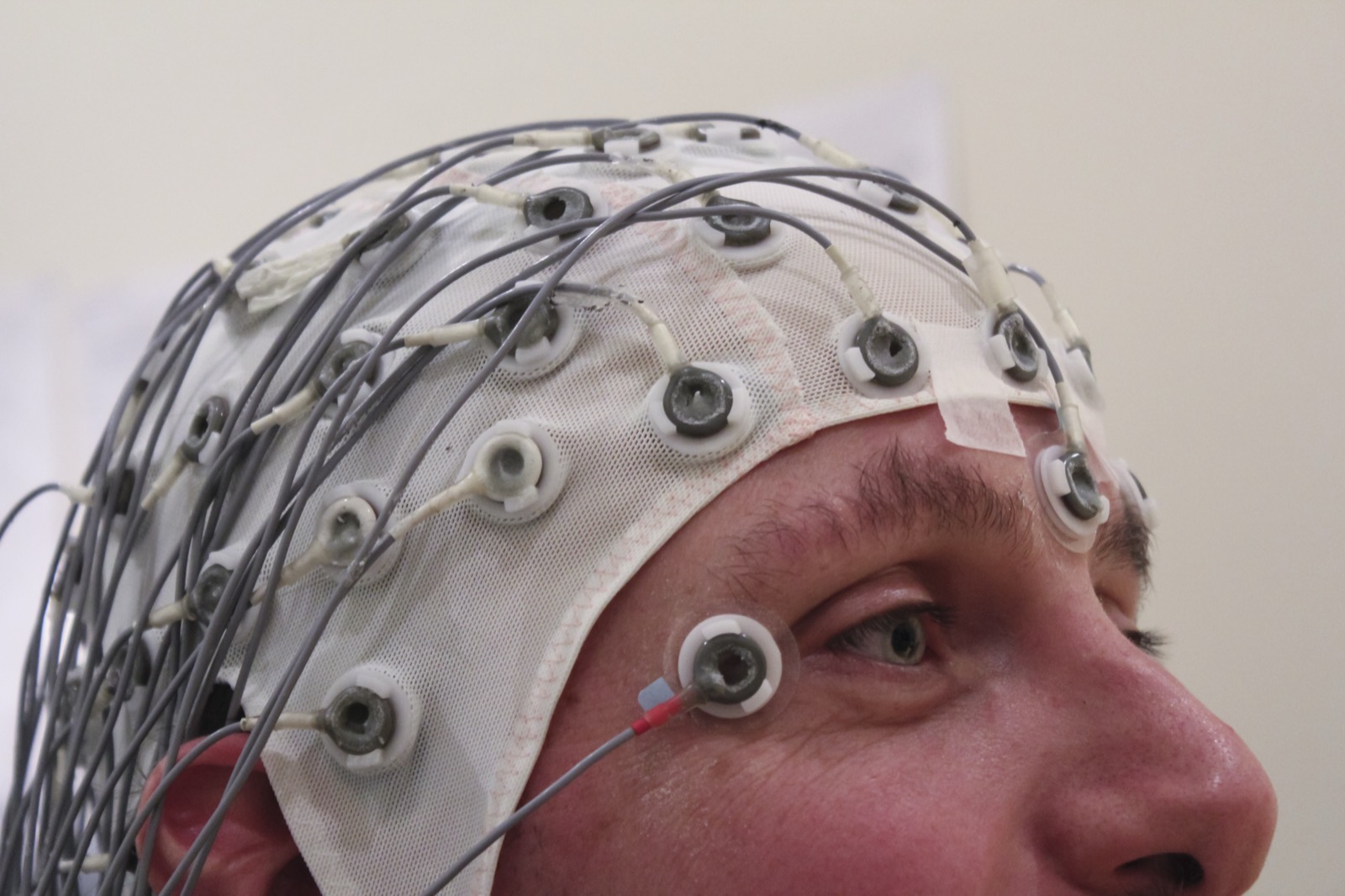
Each room is engineered to keep electrical and acoustic interference out, so the signals you record reflect the brain rather than the building.
Rooms are shielded against ambient electromagnetic interference, protecting microvolt-scale EEG signals from line noise and nearby equipment.
Acoustic treatment isolates participants from external noise — essential for auditory paradigms and for keeping attention on the task.
Three dedicated rooms let multiple studies run in parallel and support flexible scheduling across labs sharing the facility.
The lab's Brain Products systems use active electrodes, which amplify the signal at the scalp to reduce noise and cable artifacts and to tolerate higher electrode impedances. Systems of this class (such as the actiCHamp Plus) scale flexibly from dense arrays down to smaller montages, with 24-bit resolution to capture fine-grained voltage fluctuations.
| Specification | Detail |
|---|---|
| Manufacturer | Brain Products high-density EEG (e.g. actiCHamp Plus) |
| Channels | Scalable high-density coverage — systems of this class support up to 160 channels |
| Electrodes | Active electrodes (scalp-side amplification, low-noise, impedance-tolerant) |
| Resolution | 24-bit analog-to-digital conversion |
| Environment | Electromagnetically shielded, sound-attenuated testing rooms |
Dense scalp coverage plus millisecond timing opens a broad range of electrophysiological questions.
Time-locked averaging isolates ERP components tied to perception, attention, memory, and language with millisecond precision.
Time-frequency analysis of rhythmic activity across theta, alpha, beta, and gamma bands during cognitive tasks.
High-density coverage supports scalp-level and source-space connectivity measures across distributed networks.
EEG's temporal detail complements spatial methods, enabling multimodal designs alongside other shared imaging resources.
A quiet, shielded environment supports carefully controlled visual and auditory paradigms probing selective attention.
Flexible montages accommodate diverse cognitive, developmental, and clinical-research protocols.
Complementing the high-density lab, the Wager lab / CANlab maintains four rapid-setup wet 20-channel EEG systems (Wavimed). Their quick preparation makes them well suited to dyadic and multi-participant recordings, where two people are fitted and recorded together for studies of social and interactive processes.
The EEG lab is a shared resource maintained by the BrainStörmer Lab and open to the Dartmouth research community. Reach out to discuss study design, scheduling across the three testing rooms, and system configuration.