
Prerequisite: MRI safety training
The DBIC trains research faculty, postdoctoral fellows, graduate students, and full-time research staff to operate the scanner without an MRI Technologist being present. MRI operator training is a two-part process. The first step involves becoming an operator-in-training, and the second step is completion of the hands-on training required for operator certification.
Step 1: Operator-in-training
To become an operator-in-training, you will need to book a training session; see How to book. During this training session, users will learn how to administer and follow all MRI safety scanning procedures, as well as be introduced to the skills listed under “Introduced in the first session” in Skills at each step.
Step 2: Certified scan operator
After the in-person introductory session, operators-in-training must complete at least 10 hours of hands-on training before they may use the MRI suite independently. The hours are scheduled according to the DBIC scheduling policies and must be completed under the supervision of a certified scan operator. They are recorded in an online training log, which you receive after the in-person operator training; the certified operator who supervises each session adds their initials to the log.
The final competency demonstration involves independently running a scan study from start to finish, with a human participant, under the supervision of Mike Pearl, the MRI Technologist. The session can be booked according to the DBIC scheduling policies and must be run during normal business hours.
To become a certified scan operator, researchers will need to demonstrate competence in the skills listed under “Demonstrated for certification” in Skills at each step.
Skills at each step
Each skill is introduced in the first session (Step 1) and demonstrated for certification (Step 2).
| Skill | Introduced in the first session | Demonstrated for certification |
|---|---|---|
| MRI safety screening and the pre-scan checklist | yes | yes |
| Metal detectors (handheld, pole) and their operating instructions | yes | yes |
| Airlock door to the MRI suite | yes | yes |
| Emergency procedures and incident reporting | yes | yes (thorough knowledge) |
| Positioning participants in the bore | yes | yes |
| Hearing protection (ear plugs/ear buds) | yes | yes |
| Registering participants in REDCap | yes | yes |
| Selecting and running a scan protocol | yes | yes, including checking the data transfer |
| Powering the scanner on and off | yes | yes |
| Stimulus and response devices | — | yes (independent set-up) |
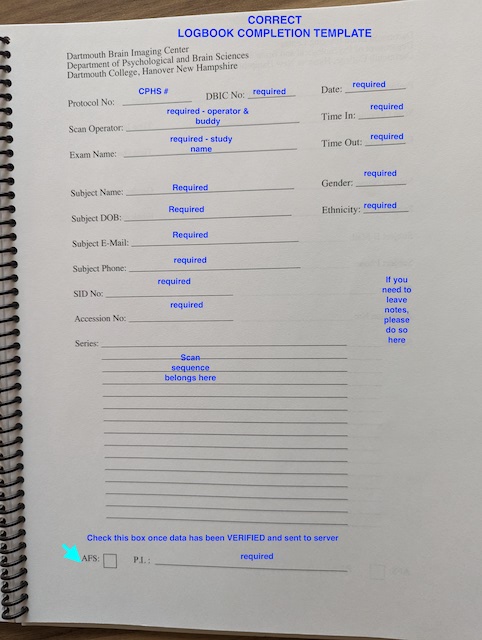
| DBIC logbook and scanner database entries | — | yes |
| Housekeeping policies; Conducting research in the DBIC | yes | — |
| MRUSER training manual | yes (study the manual) | yes (know its contents) |
What is expected of operators
Scan operators must know and follow all DBIC safety policies and procedures at all times, and must follow the housekeeping policies that protect participants and equipment.
Scheduling and class size
Training is scheduled as needed, Monday–Friday between 8 a.m. and 4 p.m. Classes are limited to 3 participants.
How to book: To book the introductory session, or for questions about certification, email Courtney Rogers.